
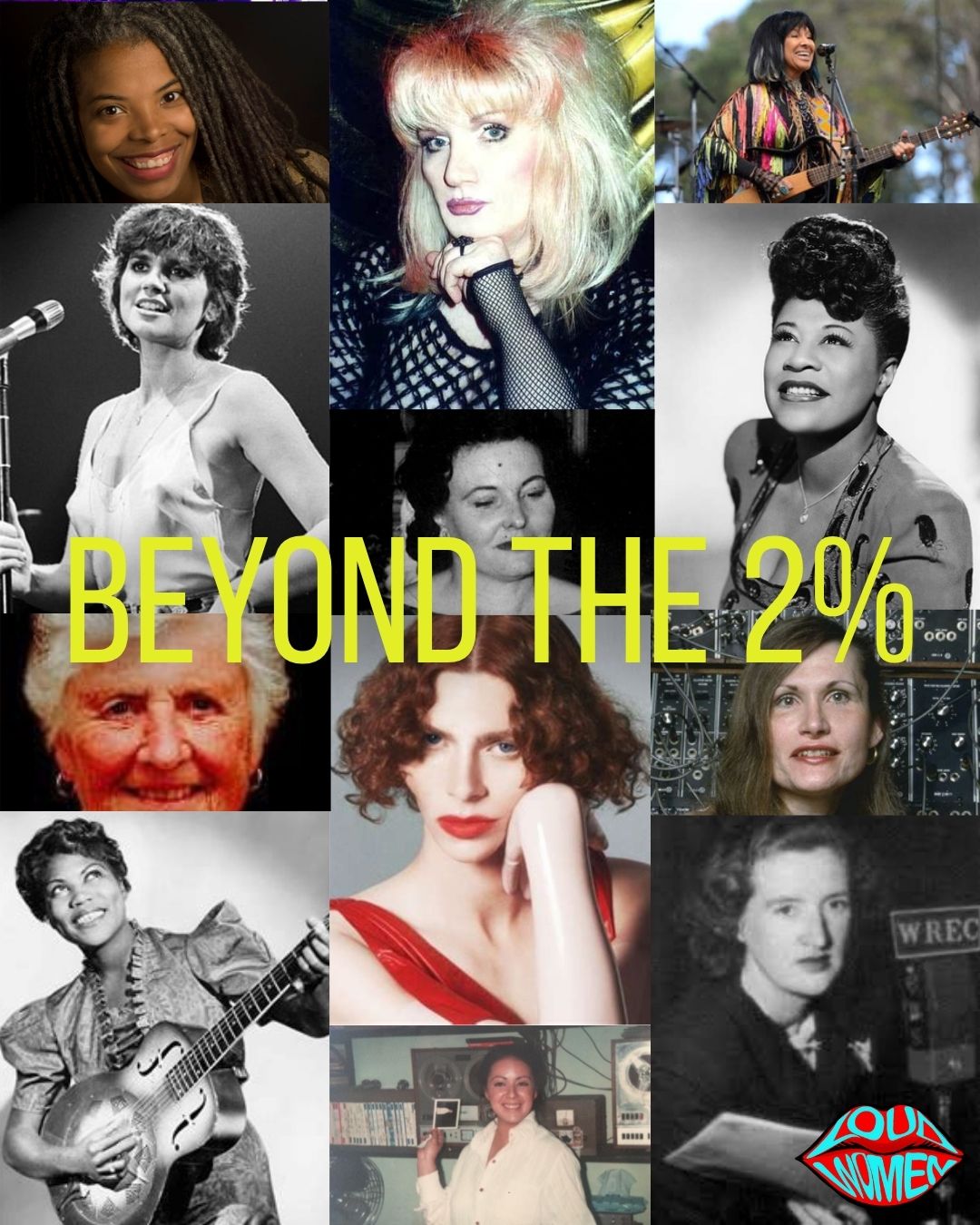
For years, a familiar statistic has been repeated throughout the music industry: “Only 2% of music producers are women.” This number, drawn from the USC Annenberg Inclusion Initiative‘s research on Billboard Hot 100 year-end charts, highlights a significant imbalance – but only in a small portion of commercial music. The data, often quoted without context, easily risks implying women, trans+ and gender-diverse producers are absent from the industry. In reality, this misrepresentation of data causes a world of independent and underground music to be overlooked.
Erin Barra, Executive Director of We Make Noise, has called out the misuse of this statistic. Using 2% as representing the entire music industry, she argues, “renders a tsunami of women invisible.” The reality is that 2% of producers on a specific sample of 900 charting songs were women – not all producers everywhere. Using charts as the only method of analysing representation disregards those outside mainstream spaces, and reinforces gatekeeping rather than addressing it.
Annenberg’s work has been vital in exposing gender gaps at the top, but without careful interpretation this headline figure risks undermining the very voices it means to amplify. Used well, it can drive change – not erasure.
Producers beyond the charts
Beyond the charts is a much broader world of women, trans+ and gender-diverse people making music – in studios, clubs, classrooms, and home setups. They may not be winning Grammys (yet), but they’re here, honing their craft and shaping audio culture. As Dr. Leslie Gaston-Bird documents in Women in Audio their presence spans decades and disciplines: from early radio pioneers to record producers, sound designers, and educators. The history is rich – just often overlooked.
So why does the myth of rarity persist? Mostly, it’s about visibility. Many women, trans+ and gender-diverse producers work in independent or underground scenes that don’t get recognised by major labels or Billboard charts. Their work is vital, but when media and industry praise focuses on a handful of male producers, it risks the erasure of others.
The 2023 Lost in the Mix report gives more detail. While it also focused on popular music – like the Annenberg study – it looked further than the Billboard Hot 100, analysing a wider range of genres and platforms. The results showed that the representation of women and non-binary producers varies significantly by genre, ranging from 0% to 17.6%. Although the variation is revealing and can provide more specific areas to focus on, even the highest numbers are still far too low.
Championing gender diversity: voices from the field
Fortunately, there are many who are working to amplify under-recognised voices. Dr. Leslie Gaston-Bird – former Audio Engineering Society (AES) President – has become a leading advocate for inclusion in emerging fields like immersive audio. In her doctoral research, she argues that as immersive tech grows, it’s vital to build equity from the start: “Fostering participation of women and other minorities… is key to ensuring a more diverse audio industry.” Her work is not just about access but about reshaping new spaces before exclusion becomes the norm.
Dr. Amandine Pras is another powerful voice for change. Her research uncovers the structural barriers facing women and gender-diverse audio professionals, especially in studio settings. In a co-authored 2021 study, it was documented how gatekeeping and frequent microaggressions – being patronised, dismissed, or told a role “isn’t for you” – push people out. As Gaston-Bird notes, these slights can be more intense than in other STEM fields. Pras’ work makes clear: the issue isn’t talent or ambition, it’s the culture that shuts people out.
Beyond the binary: missing data and the erasure of trans and non-binary identities
Discussions about “women in audio” often rely on a binary lens. Many studies categorise participants strictly as “men” or “women,” leaving trans, non-binary and gender-diverse people excluded or collapsed into an “other” category. This kind of statistical erasure sends a clear message. As Joni Seager puts it, “what gets counted counts.” Caroline Criado Perez’s Invisible Women shows how gaps in data lead to real-world harms – and the same principle applies here.
This isn’t just about numbers. When research fails to reflect the full gender spectrum, it leaves the specific experiences of trans, non-binary and gender-diverse audio professionals invisible and unaddressed. Without data, there’s no policy, no funding, and no systemic change. Inclusive research – where participants define their own gender and where gender-diverse voices are actively sought out – is essential. If we’re serious about equity in music and audio, we must recognise and include all genders: trans women, trans men, non-binary, gender-fluid, Two-Spirit, and beyond. Their work matters, and it must be seen.
The “leaky pipeline” and systemic barriers
Gender disparities in audio don’t appear overnight – they result from systemic exclusion at every stage, often described as a “leaky pipeline.” From childhood to career, barriers cause women, trans, non-binary, and gender-diverse people to become increasingly underrepresented as they advance.
But as Dr. Leslie Gaston-Bird found, this metaphor isn’t always accurate. Many “leak up, not out” – creating new paths and spaces that may be less visible but still vital. This again highlights how the issue isn’t lack of presence, but lack of recognition of these alternative paths.
Interest in music tech starts early. In the UK, around 40% of children aged 9-13 interested in audio are girls. But that number drops to 18% in secondary school courses, and below 10% by university level. This steep decline reflects a culture problem, not a skills gap. Gendered messaging – subtle or explicit – tells young people they don’t belong. Classrooms and studios remain masculinised spaces, where those who don’t conform often feel isolated or unwelcome.
Those who enter the industry face further barriers: microaggressions, underestimation, lack of mentorship, and burnout from having to constantly prove themselves. As Gaston-Bird puts it, “These are not shy or weak women; they just get tired of it.”
Structural issues compound the problem – antisocial hours, unpaid gigs, expensive gear, and networks that favour those already on the inside. As Dr. Amandine Pras has shown, gatekeepers often mentor people who look like themselves, reinforcing exclusion.
The result? Fewer women, trans+ and gender-diverse people at every senior level. This isn’t about ability – it’s about systems. Change means challenging bias in education, hiring, and leadership, and recognising the value of those who continue to contribute in spaces the mainstream too often ignores.
Support, resources, and looking forward
Many organisations worldwide are actively reshaping the music and audio industry to support and amplify women, trans+, and gender-diverse talent. Groups like Black Lives in Music, We Are Moving The Needle, Audio Girl Africa, We Make Noise, SoundGirls, Saffron, Women’s Audio Mission, and 2% Rising (and of course LOUD WOMEN) provide essential visibility, training, mentorship, and community, proving that the talent has always existed – it’s visibility and support that have been lacking. These initiatives not only empower individuals with skills but also actively work to spotlight achievements, challenge exclusionary industry practices, and push back against the stereotypes that persist.
Because even when marginalised people gain access, they often face bias before they’ve even played a note or touched a fader. People carry ingrained assumptions about who “looks like” a producer or engineer, and those biases can shape everything from hiring decisions to trust in the room. Dismantling those perceptions is just as vital as creating pathways in.
These challenges don’t exist in isolation. Gender bias often intersects with other forms of discrimination – racism, ableism, classism, homophobia – which can deepen exclusion. A non-binary person of colour navigating an industry built around white, male-dominated networks may face a very different set of obstacles than a white cis woman. That’s why intersectionality matters. True equity requires recognising how overlapping identities shape experience, and designing solutions that reflect that complexity.
To truly move forward, the industry must focus on specific actions:
- Visibility: Actively credit and celebrate women, trans, and non-binary producers, engineers, and artists through media, awards, and industry recognition.
- Resources: Financially support grassroots initiatives that nurture talent from diverse backgrounds, ensuring sustainable paths to success.
- Power: Promote gender diversity at every level – producers, A&R, studio ownership, tech development, and leadership – to fundamentally transform the industry’s structure.
- Allyship: Foster a cultural shift where sexism, transphobia, racism, ableism, and other intersecting forms of bias are actively challenged by those in positions of influence – not just those directly affected. True allyship means recognising how multiple identities shape experiences in the industry, and responding with solidarity, not silence.
Everyone can play a role in building this equitable future, whether by mentoring, supporting inclusive initiatives, or advocating for systemic change. The aim isn’t simply improving statistics, but creating an industry enriched by diverse perspectives, where gender-diverse talent thrives openly and equitably. The future of music and audio can and must be truly representative of us all.
References
Barra, E. (2021) Instagram post. Available at: https://www.instagram.com/p/CWXG_25lJ4s/?igsh=M3ozcHRrajJoZGhu&img_index=2
Born, G. and Devine, K., (2015) Music technology, gender, and class: Digitization, educational and social change in Britain. Twentieth-Century Music, 12(2), pp.135-172.
Brooks, G., Pras, A., Elafros, A. and Lockett, M. (2021) Do we really want to keep the gate threshold that high?, Journal of the Audio Engineering Society, 69(4), pp. 238–260.
Criado Perez, C. (2019) Invisible Women: Exposing Data Bias in a World Designed for Men. New York: Abrams Press.
Fix the Mix (2023) Lost in the Mix: An Analysis of Gender Representation in Popular Music Production & Engineering. We Are Moving The Needle. Available at: https://www.wearemovingtheneedle.org/fix-the-mix
Gaston-Bird, L. (2019) Women in Audio. Abingdon: Focal Press.
Gaston-Bird, L. (2022) Immersive but Not Inclusive: Challenges Faced by Underrepresented Groups in Immersive Audio. PhD thesis. University of Surrey. DOI: https://doi.org/10.15126/thesis.900955
Seager, J. (2016) Missing women, blank maps, and data voids: what gets counted counts, MIT Center for Civic Media. Available at: https://civic.mit.edu/2016/03/22/missing-women-blank-maps-and-data-voids-what-gets-counted-counts/
Smith, S.L., Pieper, K., Hernandez, K. and Wheeler, S. (2024) Inclusion in the Recording Studio? Gender and Race/Ethnicity of Artists, Songwriters & Producers across 1,200 Popular Songs from 2012–2023. USC Annenberg Inclusion Initiative. Available at: https://assets.uscannenberg.org/docs/aii-inclusion-recording-studio-20240130.pdf