
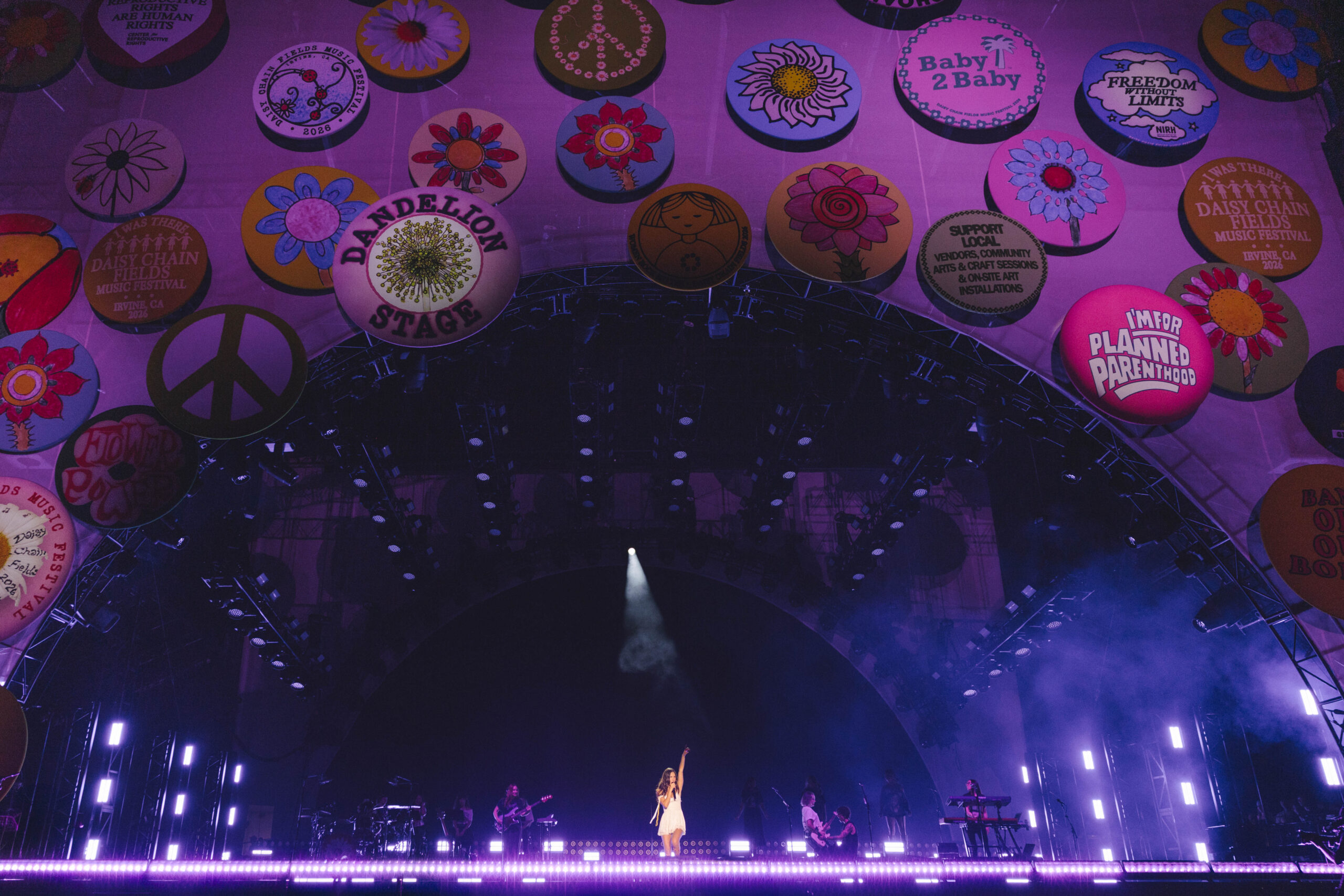
There has been a lot of excitement around Daisy Chain Fields this week, and rightly so. Olivia Rodrigo’s new festival at Great Park in Irvine brought around 45,000 people together for a lineup dominated by women, sold out in around 30 minutes, raised $10 million for organisations supporting women and girls, and then saw that figure doubled to $20 million by Melinda French Gates.[1]
It is an extraordinary achievement, but what makes Daisy Chain Fields particularly interesting is that the basic idea behind it is not extraordinary at all. Women have been making excellent music, attracting enormous audiences and creating their own stages, festivals, labels and networks for decades. Very often they have done so because the existing music industry has been strangely reluctant to let them occupy too much space in the ones already there.
Daisy Chain Fields feels significant because it has demonstrated the absurdity of that reluctance on a spectacular scale, at a point when some of the progress made on festival representation appears to be stalling, and in some places actually going backwards.
The lineup brought together Chappell Roan, Doechii, Mitski, Bikini Kill, Garbage, The Breeders, Santigold, Rachel Chinouriri, Die Spitz, Eli, Quiet Light, Not For Radio and Devon Again, alongside appearances from Sarah McLachlan, Stevie Nicks and Alanis Morissette. Across that list there are generations of punk, pop, indie, hip hop, alternative rock and singer-songwriters, which really should put paid to the peculiar idea that booking lots of women somehow means sacrificing musical variety.
Nobody looks at a festival full of men playing punk, indie, metal, electronica and hip hop and concludes that the programming is too focused on one gender. Women, however, have spent a surprisingly long time being treated as though we are a genre.
We have been here before
Sarah McLachlan’s involvement gives Daisy Chain Fields an obvious connection to Lilith Fair, which she founded in 1997 after encountering promoters reluctant to put women together on bills and radio programmers concerned about playing female artists back to back.
That genuinely was the thinking.
Lilith Fair’s response was not a symposium on audience demand. It put the artists onstage and discovered that, yes, people wanted to see them. Its 1997 tour grossed $16.7 million across 38 shows, making it the year’s most successful package tour.[2]
Nearly 30 years later, Daisy Chain Fields has generated headlines for demonstrating much the same thing.
Perhaps that is why the festival feels simultaneously joyous and slightly maddening. We keep conducting versions of the same experiment and are apparently still surprised by the result.
Haven’t things got better?
Yes. And this bit matters.
There has been progress, and it would be silly to pretend otherwise.
We have written about this ourselves before on LOUD WOMEN. Research from the Jaguar Foundation looking specifically at UK electronic and dance festivals found women and non-binary acts made up just 14% of the lineups it analysed in 2018. By 2022 that figure had risen to 28%.[3]
That is a doubling in four years.
Campaigns such as Keychange also helped force gender balance onto an industry agenda where it had been far too easy to ignore. Its pledge asked festivals and other music organisations to work intentionally towards better representation rather than waiting for equality to turn up of its own accord.
And there is evidence that this sort of conscious target-setting can work. Among Keychange signatories that provided data, 67.7% reported reaching their gender-balance target in 2023 and 67.4% in 2024. In 2025, 50.7% said they had reached their target completely, while a further 36% reported partial success.[4]
So this is not an argument that nothing has changed.
Things have changed.
The more worrying question is whether we assumed the job was done rather too soon.
Look at the festival figures now
Book More Women has been documenting festival lineups since 2018, and its figures are a useful antidote to the feeling that a few extremely successful female superstars must mean the wider problem has more or less sorted itself out.
In 2026, the differences between festivals remain enormous.
Figures shared by Amplify Her Voice using Book More Women data found women made up just 13% of the musicians booked for Stagecoach, 14.7% at Railbird and 19.4% at Bonnaroo.
Coachella reached 26.9% women. Governors Ball reached 28%.
Then look at the other end of exactly the same festival landscape: Hinterland came in at 59.6% women, while All Things Go Toronto reached 68.2%.[5]
Same year. Same music industry.
Wildly different results.
That is important because it makes it increasingly difficult to treat gender imbalance as some naturally occurring feature of festival booking, like rain or expensive chips.
People make these lineups.
Different choices produce different lineups.
And the UK isn’t exactly done either
The figures closer to home are hardly grounds for putting our feet up.
A 2026 analysis of gender and gatekeeping in UK and Irish radio and festival programming cited festival data showing women at around 18% of the Reading & Leeds lineup in 2024. Electric Picnic remained below 20%.
Latitude, meanwhile, was at around 42%.[6]
Again, the difference between those festivals is interesting in itself.
There is no single mysterious pool of “available women” distributed evenly across the country each summer. Programming decisions matter.
We also know that the imbalance becomes even starker when you look at the very top of festival posters.
In 2022, BBC Newsbeat analysed 200 headline slots across 50 leading UK festivals. Just 26 – 13% – went to female solo artists or all-female bands. Another 24 were mixed-gender acts, one was non-binary, and 149 of those 200 headline slots went to male solo artists or all-male bands.[7]
That was particularly galling because 2022 was the year by which many festivals had previously pledged to be approaching 50:50 representation.
How you count matters
There is another problem with festival gender statistics, and it is quite a big one.
What exactly are we counting?
For years, Book More Women used the same kind of measure commonly used in festival diversity discussions: an act counted as “gender diverse” if it contained at least one woman or non-binary musician.
There is an obvious problem with that.
Imagine a five-piece band containing four men and one woman. Under that method, the band is a tick in the gender-diverse column.
Put five women onstage and that band is also one tick in the gender-diverse column.
On a spreadsheet, those two acts look identical.
Onstage, they really don’t.
So in 2024 Book More Women changed its methodology and started researching the permanent members of every act, counting the individual musicians rather than simply the names printed on the poster.[8]
And the numbers changed rather dramatically.
Across nine major US multi-genre festivals in 2025, the old method suggested that 38% of acts featured at least one woman or non-binary musician.
Count the actual musicians, and women made up 21.6% of the people booked. Non-binary musicians made up 1.6%. Men accounted for 77.4%.[8]
Zoom out further and it gets worse.
Across all 42 festivals Book More Women analysed in 2025 – 5,385 musicians in total – 18% were women, 1% non-binary and 81% men.[9]
Across 130 festivals researched over 2024 and 2025, the combined figure was 17.3% women, 1% non-binary and 81.7% men.[8]
Those numbers tell us something that a reasonably diverse-looking festival poster can hide.
You can book a decent number of female-fronted acts while the people playing drums, guitar, bass, keys and everything else around those frontpeople remain overwhelmingly male.
This is not an argument against celebrating female-fronted bands. God knows LOUD WOMEN does plenty of that.
It is an argument for asking the next question too: who actually gets to be a musician on those stages?
Girls need to see female drummers. Female lead guitarists. Bassists. Producers. Musical directors. Engineers. People behind the desk and beside the stage as well as holding the microphone in the middle of it.
Visibility needs some depth.
Progress can go backwards
Book More Women’s longer-term figures are especially interesting because they show that campaigning did have an effect.
Using its original act-based measure, representation at the major festivals it tracked rose from 28% in 2018 to a peak of 40% in 2024.[10]
That is real progress. It deserves acknowledging.
Then in 2025 the figure fell, for the first time since Book More Women began tracking festival representation.
Eight of the nine major US multi-genre festivals in its annual study booked fewer gender-diverse artists than they had the previous year.[9]
There is an even more sobering statistic buried in that research.
Across 71 editions of those nine major festivals between 2018 and 2025, only three lineups ever reached 50% gender-diverse representation even using the more generous old method, where an entire band counts if it contains just one woman or non-binary musician.
Three out of 71.
Boston Calling did it in 2023 and 2024. Outside Lands did it in 2023.
That was the lot.[8]
So when an event like Daisy Chain Fields arrives and puts women right across its bill, it is not demonstrating some miraculous new discovery. It is showing what happens when somebody decides representation matters at the beginning of the booking process rather than noticing the gender balance once the poster is finished.
The headliner problem is really a pipeline problem
This is one of the festival arguments we have definitely had before.
Whenever a major festival is criticised for having very few women at the top of its poster, somebody will eventually point out that there are fewer women available at headline level.
There is an element of truth buried in there. There are fewer women at that level.
The more useful question is: why?
Festival headliners do not hatch fully formed backstage at Worthy Farm.
Artists build careers by playing small venues, support slots, tiny stages at festivals, slightly less tiny stages at festivals and eventually bigger ones. They meet promoters, agents, photographers, writers, DJs and other musicians. Someone takes a chance on them. Somebody else sees that show and takes another one.
Those opportunities accumulate.
If women and non-binary musicians are underrepresented throughout that process, it is hardly surprising when there are fewer of them available at the very top of it.
You cannot spend years narrowing the pipeline and then complain about what comes out of the other end.
This is where grassroots festivals matter
And this is, inevitably, where LOUD WOMEN comes into the story.
LOUD WOMEN started in 2015 because I was tired of looking at gig and festival posters with barely any women on them. The obvious response was to start booking the bands I wanted to see.
There was never any shortage of them.
Eleven years later, this Saturday LOUD WOMEN Fest London takes over Rich Mix with 19 artists across two stages: Bill Ricky + Bullshit Boy + Diva Cup + FOLKULAKA + French Toast + Hagar the Womb + I, Doris + Lady Lazarus + Lilith Left the Garden + Maria Uzor + MADELINE + Muddy Summers & the Dirty Fieldwhores + Second Idol + SheBeat + Shiv and the Carvers + Skint Knees + The NaNaz + THWACK! + WREX.
They come from the UK, Canada, Germany, the USA, Ukraine, Australia, the Netherlands and beyond. They make wildly different music and they are at completely different points in their careers.
There could easily have been another 19.
The difficult parts of running a grassroots festival are finding the money, paying artists properly, keeping ticket prices accessible, finding suitable venues, sorting backline, travel, accommodation, accessibility, volunteers and the approximately 6,000 other things that apparently need doing before anybody plays a note.
Finding brilliant women and gender-diverse artists has never been the problem.
LOUD WOMEN Fest London is at Rich Mix this Saturday, 5 September – get tickets here.
And these smaller stages matter because this is where musicians get the experience, audiences and connections that might eventually take them somewhere much bigger.
We have seen that process ourselves. Artists who have come through LOUD WOMEN have gone on to play bigger festivals, bigger tours and bigger rooms. At Rebellion Festival, where LOUD WOMEN has programmed the Introducing Stage on Sundays since 2024, we have already watched artists from our stage return in later years to play further up the festival.
That is what a pipeline actually looks like when you open it.
And the network is getting bigger
This year LOUD WOMEN Fest itself has become properly international.
After London and LOUD WOMEN Fest Newport in October, we head back to Nova Scotia for LOUD WOMEN Fest Halifax on 24 October – tickets here.
Then comes our first LOUD WOMEN Fest Toronto on 6 November – tickets here, followed the very next night by our first LOUD WOMEN Fest Colorado at the Fox Theatre in Boulder – tickets here.
On 14 November we hold our first LOUD WOMEN Fest Tokyo at Shinjuku MARZ, before finishing the year in Australia with LOUD WOMEN Fest Sydney on 21 November, Melbourne on 22 November and Brisbane on 29 November.
The point is not to export a London festival around the world as though we have arrived bearing feminism for everybody.
Quite the opposite.
Each festival depends on people already embedded in those local scenes: musicians, promoters, venues, activists and volunteers who know the artists and communities around them. The useful bit is connecting those scenes together.
A Canadian band comes to London. A British band plays Colorado. Artists meet each other at one festival and find themselves sharing a bill somewhere else. People swap contacts, recommend bands, lend equipment, offer floors to sleep on and help each other navigate unfamiliar cities.
It is not the glamorous end of the international music business, but it is a very real one.
Daisy Chain Fields understood that a festival can do more
The other reason Daisy Chain Fields feels important is that the politics did not end with the lineup.
The festival supported ten organisations working across reproductive healthcare, maternal health, domestic abuse, economic justice and legal rights, including Planned Parenthood, Black Mamas Matter Alliance, the Center for Reproductive Rights and the National Women’s Law Center.[1]
Those organisations were part of the physical festival space rather than names quietly listed on a webpage afterwards.
That changes the purpose of a festival.
Music is extraordinarily good at gathering people together who might otherwise never share a room, venue or enormous Californian field. Once they are there, you can introduce them to bands, organisations, campaigns, ideas and, most importantly, one another.
That is one of the things feminist DIY music has understood for a very long time.
It is why LOUD WOMEN Fest has always involved more than the musicians onstage too. Campaigners and community organisations are part of the day because music scenes are communities, and communities have the potential to support people as well as entertain them.
A festival can be more than a row of bands and a bar.
This is bigger than ‘women in music’
There is also an obvious danger in reducing all of this to a triumphant “girls are doing it for themselves” story.
Gender inequality does not happen in isolation.
Race, disability, sexuality, class, age, caring responsibilities, money and access to professional networks all affect who gets into the music industry, who can afford to keep going and who gets heard.
Trans and non-binary musicians need to be part of this conversation too, not tucked conveniently under the word “women” whenever somebody needs to improve a diversity statistic.
And equality certainly does not mean recreating exactly the same industry structures and simply installing a few more wealthy cis women at the top.
We can aim a little higher than that.
Perhaps the most interesting thing about Daisy Chain Fields is how normal it looked
Forty-five thousand people went to a music festival.
They watched an excellent and varied lineup.
They discovered organisations doing important work.
They had a brilliant time.
The tickets disappeared in around half an hour.[1]
Seen like that, there is nothing particularly revolutionary about Daisy Chain Fields at all.
That might be the most revolutionary thing about it.
The music industry has been discussing gender-balanced festival lineups for decades. We have made some genuine progress. We have gathered mountains of evidence. We have run campaigns and pledges. We have proved that deliberate booking can change the numbers and proved, repeatedly, that audiences will turn up.
The current statistics tell us that the work is nowhere near finished, and that progress can disappear frighteningly quickly when people assume the problem has already been solved.
Daisy Chain Fields is worth celebrating not because it has discovered that women can carry a festival.
Lilith Fair demonstrated that in 1997.
Grassroots festivals have demonstrated it constantly ever since.
What Daisy Chain Fields has done, very loudly and in front of 45,000 people, is remind everybody.
And if anyone would like to inspect the grassroots end of that argument for themselves, LOUD WOMEN Fest London is at Rich Mix this Saturday – get your tickets here.
There are 19 rather good examples on the bill.
Footnotes
[1] Daisy Chain Fields, 2026. The Los Angeles Times reported a sold-out crowd of 45,000 and that tickets sold out around 30 minutes after release. Universal Music’s post-event announcement confirms $10 million was raised for ten nonprofits, with Melinda French Gates pledging a further $10 million, bringing the total to $20 million.
Los Angeles Times: Daisy Chain Fields | Universal Music: post-event announcement
[2] Lilith Fair, 1997. The Washington Post reported that the first Lilith Fair grossed $16.7 million over 38 shows and was the most successful package tour of 1997.
The Washington Post: ‘Lilith Blossoms’
[3] Jaguar Foundation, Progressing Gender Representation in UK Dance Music, 2022. The study examined 22 electronic/dance festival lineups from 2018–22 and found women and non-binary acts comprised an average 14% of lineups in 2018, rising to 28% among the 2022 lineups available for analysis.
Resident Advisor: report summary
[4] Keychange Pledge Research Report 2023–2025. Of reporting signatories, 67.7% met their gender-balance target in 2023, 67.4% in 2024 and 50.7% in 2025. The 2025 survey introduced a partial-success category, reported by a further 36% of respondents.
Keychange: Pledge Research Report
[5] 2026 festival lineup figures. Amplify Her Voice published Book More Women data giving the following individual-musician breakdowns: Stagecoach 13% women; Railbird 14.7%; Bonnaroo 19.4%; Coachella 26.9%; Governors Ball 28%; Hinterland 59.6%; and All Things Go Toronto 68.2%.
Amplify Her Voice: 2026 festival representation data
[6] UK and Irish festival data, 2024. A 2026 peer-reviewed paper examining gender, power and gatekeeping in UK and Irish music cites festival datasets putting women at around 18% of Reading & Leeds’ 2024 lineup, below 20% at Electric Picnic and around 42% at Latitude.
Frontiers in Communication: ‘Why Not Her? Gender, power, and gatekeeping in Irish and UK radio and festival programming’
[7] BBC Newsbeat UK festival headliner analysis, 2022. Across 200 headline slots at 50 major UK festivals, 26 – 13% – went to female solo artists or all-female bands; 149 went to male solo artists or all-male bands, 24 to mixed-gender acts and one to a non-binary artist.
Musicians’ Union: BBC festival-headliner research
[8] Book More Women methodology and longer-term analysis. Book More Women changed its principal methodology in 2024 from counting acts containing at least one woman or non-binary member to counting every permanent musician individually. For nine major US festivals in 2025, the older method produced 38% gender-diverse acts, while the individual count found 21.6% women, 1.6% non-binary musicians and 77.4% men. Across 130 festivals researched in 2024 and 2025, 17.3% of musicians were women, 1% non-binary and 81.7% men. Only three of 71 editions of the nine major festivals tracked between 2018 and 2025 reached 50% gender-diverse representation under the older, more generous measure.
Book More Women: How Book More Women Measures Representation
[9] Book More Women 2025 data. Across all 42 festivals analysed in 2025, Book More Women counted 5,385 musicians: 18% women, 1% non-binary and 81% men. Among nine major US multi-genre festivals, eight booked fewer gender-diverse artists than in 2024.
Book More Women: Press and data facts
[10] Book More Women historical trend. Using its legacy, act-based measure, Book More Women recorded gender-diverse representation increasing from 28% in 2018 to a peak of 40% in 2024. In 2025 it declined for the first time since tracking began.
Book More Women: ‘Welcome to the Next Chapter’